Gratis te bezoeken in Brugge
Brugge biedt heel wat moois dat je gratis kunt ontdekken. Denk aan sfeervolle wandelingen, historische gebouwen van buitenaf, kunst in de openbare ruimte en gezellige pleinen. Ideaal voor wie de stad wil beleven zonder kosten.
 The very photogenic Boniface Bridge may be one of the youngest bridges in Bruges, but it sums up the city perfectly...
 The Omookaai is situated at the end of a peninsula, right between the busy container port and the former fishermen's quarter...

-

 This magnificent 15th century city palace was built to impress, and it’s been doing so in style ever since...

 The Belfry attracts all the attention, but behind it there’s a hidden, secret place: the Carthusians’ Street, named for the nuns who lived here until the end of the 18th century...

-

 In Bruges, you often get the feeling that you’ve strayed into a picture postcard, and nowhere is that more true than on the King’s Bridge...
 The romantic charm of the Wijngaardplein is simply irresistible to passers-by, but take your time here - there is a lot to see...

 An alley so narrow that you almost walk straight past: that’s Stoofstraat, where you can barely stretch out your arms...

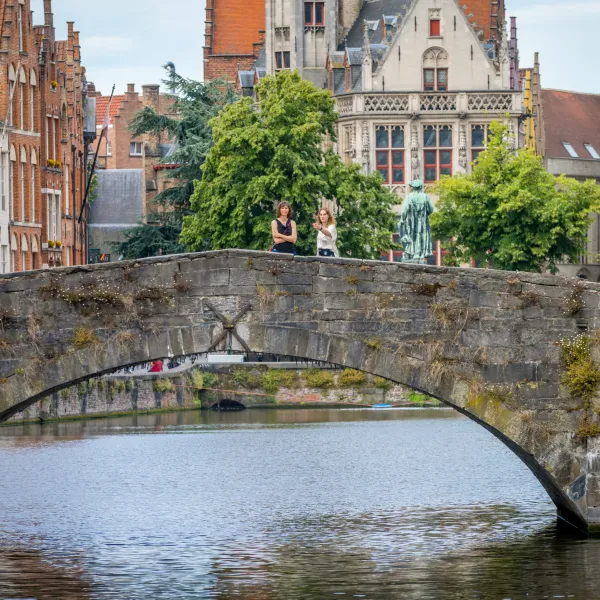
 The Nepomucenus Bridge may be a bit of a tongue-twister, but the bridge boasts a statue of the patron saint of bridges...

-

 The panoramic viewing platform at the base of the Swedish Quay, a real peninsula that forms the link between the outer and inner ports...

-

 Benedictine nuns from Gistel settled here as early as 1623 after the turbulent Beggars (‘Geuzen’) era...

 This mysterious burial ground is not only the oldest in Belgium, it is also a wonderful place of silence within walking distance of the city centre...

-

 Niobe, is distraught, absolutely inconsolable and her tears ‘flow’ incessantly into the river Reie...

-

 The beating heart of Bruges has long been dominated by the Belfry, 83 metres high and the city’s most prominent building...

-

 The Ezelstraat, one of the most important roads leading from a city gate, is a street just waiting to be explored...

 The first Kruispoort gate was built simultaneously with the second rampart (1297-1304) and already rebuilt in 1366...

 The Old Water House, built on the city ramparts, guaranteed water supplies to the medieval city and even then was regarded as one of the wonders of Bruges...

 This Gothic mansion was built in the second half of the 15th century by Jan III de Baenst (1483), a local politician and chamberlain of the Duke of Burgundy...

-

-

-

-

-

-

-

 The church tower of the Gothic Our Lady of the Visitation Church was built in 1265 but never completed when funds ran out...

-

-

 Ever since the Middle Ages, the most important saint for fishermen has been Maria, who is identified with the Stella Maris, or Star of the Sea...

-

-

 Fresh North Sea fish used to be a delicacy for the rich, and was originally sold on Market Square...

-

 The oak forest that gave its name to Groeninge has disappeared, but thanks to a water pump, a small hidden canal and the cheerful clatter of hooves this ancient street is still oozing with charm...

-

-

-

-

 The world port of Zeebrugge is the second-largest port in Belgium and is inextricably linked to Bruges...

-

 In 1619, a Bruges lay brother, Pieter Huyssens, was commissioned to build a prestigious church that expressed the values and beliefs of the Jesuits...

-

 The first Blacksmith’s Gate dates from 1297-1299; the current gate was built on the remains of the old one in 1367...

-

-

-

-

 In this church, the only one in the city centre with a tower clock, many of the great Bruges artists have been buried...

-

 Giuseppe Penone thanks the nurses of the St John's Hospital for their efforts in caring for the body and soul of everyone who has ever stayed here...

 The Basilica of the Holy Blood was elevated to the status of Basilica in 1923, due to the special veneration of the Holy Blood...

 The imposing Gunpowder Tower is located next to the Lovers' Bridge and is an impressive 18 metres tall...

 Windmills have graced Bruges’ ramparts ever since the construction of the outer city wall at the end of the 13th century...

 The 13th-century brick Church of Our Lady of Visitation is a textbook example of ‘coastal Gothic’...

 In memory of all the fishermen who never returned, a sixteen-meter-high concrete cross was erected in the fishing port as early as 1936 in line with the plans of Bruges architect Jozef Viérin...

-

-

-

 The gaze of anyone visiting the picturesque Beguinage will be drawn to the centrally located Beguinage Church...

-

 This 14th-century farmstead houses a merry working children’s farm with a superb recreation area and a gaggle of farmyard animals...

-

-

-

 80 homes on 1 hectare of grounds: these won Pandreitje a well-deserved Belgian architecture Award...

-

 This corner, where the Grauwwerkersstraat turns into the Academiestraat, is popularly known as the 'Oude Beursplein' (Old Stock Exchange Square)...

 If you’re searching for a peaceful place to rest by the water in the heart of the city, head for the small but delightful Capuchins’ Square...

 The Carmelite Bridge stands at the epicentre of the canals and is also one of the city’s many renowned sights...

-

 If Bruges’ residents, driving or cycling along the Potterierei or the Langerei, suddenly realise they need to be on the side of the canal, they turn off onto the Snaggaard Bridge, which was probably named after the local Snaggard family, mentioned in documents as far back as the 12th century...

 Don’t worry if you can’t choose between the 14th century Meebrug and the 17th century Peerdenbrug...

 Time has not stood still in Bruges, and so it happens that the medieval access roads are not always fit for 21st century traffic...

-

 Above, below, left, right, ahead and behind you: in Blind Donkey Street every square metre has something to notice...

-

-

-

-

-

-

-

-

-

-

-

-

-

 The mathematician and physicist Simon Stevin (born in Bruges in 1548, died in The Hague in 1620), after whom the square is named, stands proud on this lively square, which is framed by neat rows of linden trees...

 The work of art by Jean Bilquin that forms part of the Beaufort Sculpture Park along the Belgian coast...

-

 Each and every one of the city’s lovely canals is a jewel, but without doubt the loveliest is the Groenerei...

-

 This literary and biographical museum about the life of Guido Gezelle (1830-1899), one of Flanders’ most famous poets, was established in the house where he was born, situated in a peaceful working-class district of the city...

-

 It can get very busy at Musea Brugge's reception pavilion at times, as this is where you buy your entrance ticket for the top locations of Gruuthuse Museum and the Museum of the Church of Our Lady...

-

-

 Bruges’ oldest parish church (12th–15th century) has amongst its treasures a rood loft with an organ, medieval tombs, Brussels tapestries and a rich collection of Flemish paintings (14th-18th century)...

-

-

-

 This simple Gothic single-nave church, built in the 17th century, surprises with the opulence of its rich Baroque interior - the result of donations by wealthy local patrons...

-

 The old fishing port exudes great atmosphere and conviviality; the appealing no-nonsense ambience comes for free...

-

 Parish church in simplified Gothic Revival style that was originally built around 1910, then rebuilt in 1951...

-

-

-

-

-

 Tucked away between the Fish Market and the Rosary Quay, you’ll find the Tanners Square, one of the intimate little squares with which Bruges abounds...

-

 St Magdalene’s Church (Madeleine in Brugge) is one of the earliest neo-Gothic churches in continental Europe...

 The Lake of Love may often steal the show, but do be sure to take some time to check out the Lock keeper's house as well...

 The enchanting Pottenmakersstraat meanders partly along the water, and rewards you with surprising discoveries...

 The 'Princely Beguinage Ten Wijngaerde' with its white-coloured house fronts and tranquil convent garden was founded in 1245...

-

-

 Discover the enchanting sounds played by the Bruges harp player Luc Vanlaere, who transforms the Old St John site into an oasis of tranquillity with his music...

-

-

 With its bobbing boats, the Coupure is a taste of the South of France in the city centre, a delightful haven of rest...

 The name of this small cobbled square possibly refers to the first city walls, built nearby in 1127-1128...

 Even if you’ve never heard of Guido Gezelle, the famous Flemish poet-priest, it’s impossible to miss his statue in this splendid spot...

-

 This residential area with social housing in West Bruges might seem light-hearted, but make no mistake...

-

 A 'surprisingly ‘strokeable’ sculpture named ‘Untitled’ adorns the Groeninge Museum's courtyard garden...